



Magnesium in Horse Feeds: Effects, Requirements and Tips
Like calcium, phosphorous, potassium, sodium, chlorine and sulphur, magnesium is a macroelement. These seven macroelements are essential for the body’s vital functions so it is important to consistently feed them to horses. But which horses should be given feed supplements and what effect can they have?Why is magnesium so important for horses?
Magnesium is important for bone mineralisation and for the function of countless enzymes, especially in the nerve and muscle tissue. Many horses benefit from having magnesium added to their feed.Magnesium is also involved in the intermediary metabolism of carbohydrates, fats and proteins; the formation of nucleic acids; ion transport through the cell membrane; and neuromuscular excitability (muscle spasms). It is also an important element for cell growth and cell proliferation, as well as calcium homeostasis to maintain balanced physiological functions.
What is the best way for your horse to absorb magnesium and where is it stored in the body? (H2)
Before magnesium can be absorbed, it must be released from its bound form. This is done with the help of the stomach acid, among other things. Horses absorb around 45–60% of the magnesium in feed in the front part of their small intestine. This means that not all the magnesium in feed is available to the body.
Magnesium is primarily stored intracellularly in the bones (60%) and musculature. Only 30% of magnesium in bones is easily exchangeable and is therefore available as a reservoir for maintaining extracellular magnesium concentrations. The remaining 70% of the magnesium in the bones performs structural functions. It is contained in the hydroxyapatite lattice and is only released during active bone resorption.
The magnesium in the blood serum only makes up around 1% of all the magnesium in the body and is divided into three types:
- protein-bound magnesium (20–30%), in particular magnesium bound to albumin and, to a lesser extent, globulin
- free, ionised magnesium, which makes up the largest portion
- magnesium that forms complexes with anions, such as phosphate, bicarbonate and citrate, which forms the smallest portion
Correct magnesium dosage: What to look out for
Essentially, the relative bioavailability of magnesium is higher when it is given in several low doses throughout the day, compared with a single high dose once a day. The absolute absorption increases with dosage. Magnesium absorption can also be influenced by physiological factors, such as age and the other nutritional components of the feed.Too much magnesium in the body
An excess of magnesium is mainly caused by feeding too many supplements that contain magnesium.Overfeeding up to three or four times the actual requirement is not normally a problem. However, in conjunction with an excess of phosphorus, excessive magnesium can result in an increased risk of kidney gravel or kidney stones. Enteroliths (stony concentrations within the gastrointestinal tract) can also form in rare cases.
In high doses, magnesium sulphate can promote ileocecal (= the transition between the ilium and the cecum) water flow and therefore cause diarrhoea. This effect is used therapeutically to relieve constipation.
Most of the excess magnesium that the body doesn’t need is excreted via the kidneys. It can also be secreted in the large intestine.
Mares also pass on magnesium in their milk during lactation.
A small quantity of magnesium is lost through sweat, which is why ridden horses need slightly more magnesium compared to horses that just require a maintenance dose. Performance and sport horses or endurance horses that sweat a lot will correspondingly have higher requirements. However, the requirements during lactation and growth are much higher.
What are the symptoms of magnesium deficiency in horses?
Magnesium requirements are often covered by feeding enough fibre.However, a deficiency can occur on intensively fertilised pasture with unbalanced vegetation. Old and woody plants often have a lower magnesium content. A higher magnesium content is found when there is a higher proportion of clover-like plants and herbs. Riding horses, lactating mares and young horses whose requirements are higher are more likely to be affected by a deficiency than horses that only need magnesium for maintenance purposes.
A deficiency in horses can also be due to insufficient magnesium absorption, such as in bouts of diarrhoea.
Symptoms of this kind of magnesium deficiency can include increased anxiety, muscle tremors, muscle cramps and even tetany (a type of muscle spasm). Weakness, cardiac arrhythmia, cramps, seizures, ataxia and coma can also be symptoms of hypomagnesemia.
How can I establish whether my horse has a magnesium deficiency or excess magnesium?
An extreme magnesium deficiency or excess is easily detected in serum or plasma values.However, since less than 1% of the total magnesium in the body is found in the extracellular fluid, the magnesium concentration in the serum may not accurately reflect the total magnesium stored in the body. It is important to remember this when doing a blood test.
The following factors can influence magnesium concentration in the blood/serum:
Hypoproteinaemia, which leads to a reduction in protein-bound magnesium, can influence the total magnesium concentration in the blood. The concentration of ionised magnesium depends on the acid–base status. Acidosis (a change in the blood pH value towards the acidic range or acidification) increases the Mg2+ concentration, while alkalosis (an increase in the blood pH value towards the base area) reduces it.Other possible factors that can influence the magnesium content in the blood are absorption via the digestive tract, as well as excretion via the kidneys, intestines or the mammary glands during lactation. Hormonal influence through the parathyroid hormone (PTH), 1,25-dihydroxycholecalciferol, as well as thyroxine and aldosterone, can also potentially influence the total quantity of magnesium in the blood.
The following are examples of indications/reasons for investigating the magnesium content in the blood: diseases of the digestive tract, renal disfunction, increased diuresis (= urine excretion), hypercalcemia, hypokalaemia, tetanic spasms, flaccid paralysis and parturient paresis (milk fever). Hyperthyroidism and hyperparathyroidism (where the parathyroid hormone level in the blood increases due to hyperfunction of the parathyroid gland) are also indications. However, these two conditions are very rare in horses.
In addition to investigating magnesium levels in the blood, a feed ration calculation usually provides useful information about the magnesium supply in horses. You will find free, personalised feeding advice here: Agrobs feeding advice
Organic and inorganic magnesium compounds
European Union law regulates which magnesium compounds are permitted for horses. We differentiate between organic and inorganic magnesium compounds.Inorganic compounds include magnesium oxide, magnesium chloride and magnesium sulphate. Organic magnesium compounds include magnesium salts of organic acids, such as magnesium citrate, magnesium fumarate and magnesium chelate. Chelated magnesium refers to magnesium that is bound to amino acids, such as magnesium glycinate (bound to the amino acid glycine), magnesium aspartate (bound to aspartate) and magnesium lysinate (bound to lysine).
Solubility of organic and inorganic magnesium compounds:
As mentioned above, magnesium must be released from its bound form before it can be absorbed. This is normally done by the stomach acid.Inorganic compounds appear to be less soluble compared to organic compounds, so organic compounds are normally better absorbed. Inorganic magnesium salts, on the other hand, need a clearly acidic pH value to be released from the compound. All magnesium salts are at their most soluble at an acidic pH value of 5, which is found in a horse’s stomach under normal circumstances. When pH values increase to 6-7, there are clear differences in the solubility of magnesium salts.
Studies have shown that organic magnesium salts are more water soluble than inorganic salts. This means that magnesium citrate, which is more water soluble as an organic magnesium salt, is better absorbed compared to magnesium oxide. This is reflected in results where plasma concentrations and urine excretion at different times after administration were higher than in the case of magnesium oxide. At pH values of 8-9, magnesium citrate and magnesium gluconate normally have very good solubility. The small and large intestine of horses have a pH value of 6-8, depending on the region.
Solubility in the event of illness:
Diseases such as gastritis, and medication that influences acid secretion, reduce the solubility and therefore the absorption of magnesium oxide and magnesium carbonate. By comparison, organic magnesium citrate has good solubility in a slightly acidic environment so is more suitable as a magnesium compound in such cases. It can have a laxative effect at higher doses.Magnesium oxide contains 60.25% elemental magnesium. Magnesium sulphate contains 20.2% elemental magnesium. By contrast, magnesium citrate contains approx. 15%, magnesium glycinate 14% and magnesium fumarate 11% elemental magnesium. This shows that even when the bioavailability of magnesium appears lower, it delivers much more elemental magnesium overall. Magnesium oxide can cause diarrhoea at higher doses.
Magnesium glycinate and magnesium bis-glycinate are chelated magnesium. That means the magnesium that is bound to the amino acid glycine. Glycine is an important, non-essential amino acid. This amino acid is either absorbed through food or produced in the body from choline, serine, hydroxyproline and threonine. However, under normal conditions insufficient quantities of glycine are often produced.
Along with GABA (gamma-aminobutyric acid), glycine performs an important function as an inhibitory neurotransmitter in the body’s central nervous system. This means that it inhibits excitatory conduction in the nerve cells.
Furthermore, glycine performs antioxidative, anti-inflammatory and immunomodulatory functions. Because of its function as an inhibitory neurotransmitter, glycine is said to have a calming effect.
Unlike other magnesium compounds, magnesium glycinate does not have a laxative effect.
However, external factors, such as other feed ingredients, appear to have the biggest influence on the absorption of magnesium. Whether the magnesium is given in one dose or divided into several doses throughout the day also has a decisive influence.
In summary, it can be said that further studies into the absorption, dispersion, metabolisation and excretion of different magnesium compounds are necessary to better understand how to use them effectively.
Influence of magnesium on the musculature and nervous system
Magnesium is also important as an activator and component of numerous enzymes involved in nerve excitability and muscle contractions.Clinical signs of hypomagnesemia include tremors, tetany, weakness, anorexia, apathy and, in rare cases, seizures. The increased excitability of muscles and nerves in cases of magnesium deficiency is attributable to the increased release of the neurotransmitter acetylcholine from the nerve endings and the increased intracellular calcium content in the skeletal musculature. A neurotransmitter is a messenger in the body that transmits stimuli between the nerve cells.
Increased absorption of magnesium improves physical performance.
In a comparison between healthy and lame horses, it was established that calcium, inorganic phosphate and magnesium levels in the blood of lame horses were lower than in healthy horses. We can assume that calcium and magnesium play an important role both in the normal functioning of the musculoskeletal system and in preventing lameness.
In humans, magnesium performs an inhibitory function in the regulation and neurotransmission (= communication between the nerve cells via neurotransmitters) of the normal stress response. We assume that stress could increase magnesium loss and cause a magnesium deficiency. Conversely, a magnesium deficiency can increase the body’s susceptibility to stress, leading to a vicious cycle of magnesium deficiency and stress. This is why magnesium products are often marketed as being for stress-prone horses, although further studies are needed before the positive impact can be scientifically confirmed.
The influence of magnesium on specific illnesses
Magnesium and equine metabolic syndrome (EMS)
Insulin influences magnesium homeostasis. However, magnesium can also influence insulin secretion, binding and activity. A magnesium deficiency influences the insulin receptor and signal transduction such that it promotes insulin resistance.It has already been proven that a magnesium deficiency can exacerbate insulin resistance in humans. Furthermore, those with type II diabetes are often deficient in magnesium. Increasing the magnesium intake through the diet in humans reduces the risk of becoming ill with diabetes mellitus and also improves insulin sensitivity.
Insulin resistance is present in diabetes mellitus type II in humans and in equine metabolic syndrome in horses.
The oral administration of magnesium appears to have a positive effect on horses with equine metabolic syndrome. In one study, following the administration of magnesium, the glucose-insulin tolerance test was negative in three out of five horses that had tested positive at the beginning of the study.
The influence of oral magnesium on insulin sensitivity was tested in a further study, and a positive effect was demonstrated here too. However, further investigations are required.
Magnesium and headshaking
Ionised magnesium concentrations below the reference range were found in some horses that suffer from headshaking. An intravenous magnesium sulphate infusion in horses with trigeminal-mediated headshaking was found to improve symptoms by 29%.A further study established that the best effect was achieved by feeding magnesium in combination with boron, so this should be considered as a treatment.
Boron raises the magnesium level in the blood, and considerably improves magnesium absorption and storage in the bones.
Magnesium and bone health
As mentioned above, magnesium is primarily stored intracellularly in the bones (60%) and musculature. Only 30% of magnesium in bones is easily exchangeable and is therefore available as a reservoir for maintaining extracellular magnesium concentrations. The remaining 70% of magnesium in bones performs structural functions. It is contained in the hydroxyapatite lattice and is only released during active bone resorption.Magnesium therefore plays an important role in bone health. A deficiency can result in reduced bone density, an increase in osteoclasts and a decrease in osteoblasts directly on the bones. It can also indirectly lead to subsequent bone loss because it influences the parathyroid hormone and vitamin D and leads to inflammation. Magnesium is an important co-factor for vitamin D synthesis into its active form.
Various studies have established a link between low magnesium levels in serum and the presence of osteoporosis in humans. People with a magnesium deficiency also have a lower bone density. An increased risk of fractures was also established.
Magnesium and equine asthma
Magnesium sulphate is already used in combination with other medications to treat severe asthma attacks in humans because of its bronchodilating effect.A magnesium sulphate infusion on its own or in combination with drug inhalation therapy improved the symptoms in horses with severe asthma.
Magnesium and ESGD (equine squamous gastric disease)
EGUS (equine gastric ulcer syndrome) refers to ulcerative changes in the stomach lining of horses. We differentiate between ESGD (equine squamous gastric disease) and EGUS (equine gastric ulcer syndrome) depending on the anatomical region. Omeprazole is the gold standard for the treatment of ESGD but it is very expensive. Alternative, cheaper and supportive treatment options are therefore of interest.Magnesium oxide can be used as an antacid. Antacids are active agents that are administered to neutralise stomach acid in cases of gastritis or stomach ulcers. However, combination therapy with substances that inhibit excretion is recommended here.
In a study on young trotters, a breed with a high prevalence of stomach ulcers, the ESGD score clearly improved compared with the control group following a 30-day course of magnesium oxide.
Feeding recommendations by type of horse: When should you feed a magnesium supplement to horses?
Many horse owners ask this question and it keeps coming up in feed advice. It goes without saying that every horse with a deficiency should be given magnesium. However, feeding magnesium can also be beneficial in horses with increased needs. People often notice positive effects when they feed a magnesium product to horses with muscular and/or nerve problems.Magnesium requirements for sport horses and nervous horses, growing horses, lactating and pregnant mares, leisure horses, senior horses
Which magnesium compound should I use?
All permitted magnesium compounds work. As mentioned above, there are differences with regard to bioavailability. For example, organic magnesium compounds are better absorbed by the body than inorganic compounds. However, you should also consider the elemental magnesium content of each compound. For example, inorganic magnesium oxide has poorer bioavailability compared to organic magnesium citrate. However, magnesium oxide contains much more elemental magnesium. This means that magnesium oxide is very good at compensating for a magnesium deficiency. Because of its different solubility and because how it is bound affects how it is absorbed, it seems to make most sense to combine several different organic and inorganic magnesium compounds to guarantee an optimal supply. If possible, magnesium should be administered several times a day to guarantee the best bioavailability of the compounds. A compound such as magnesium glycinate (also called magnesium bis-glycinate) also supplies the amino acid glycine, which has a calming effect as an inhibitory neurotransmitter.MAGNESIUM PUR from Agrobs
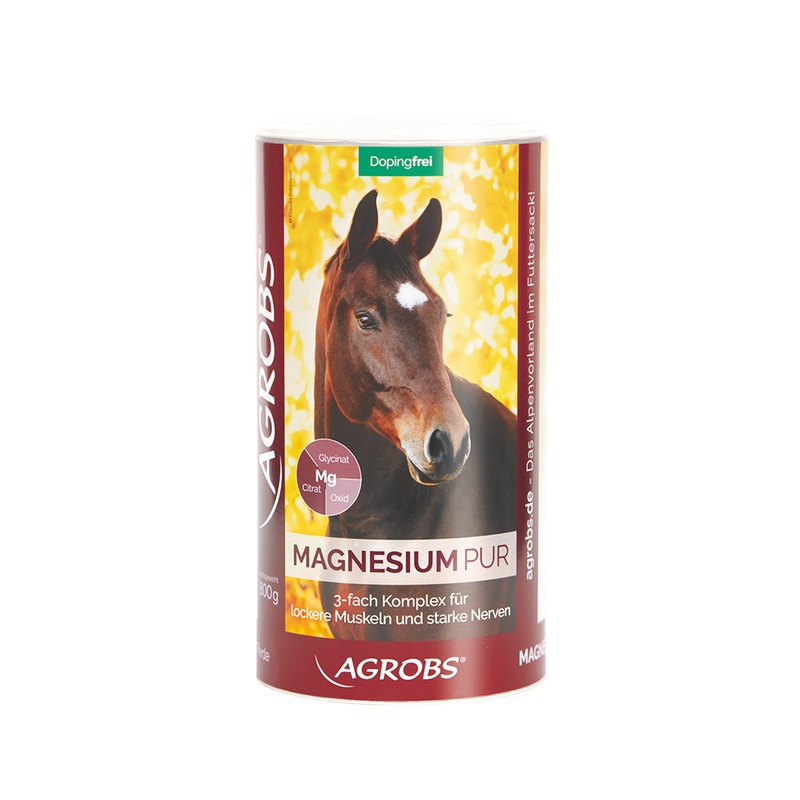
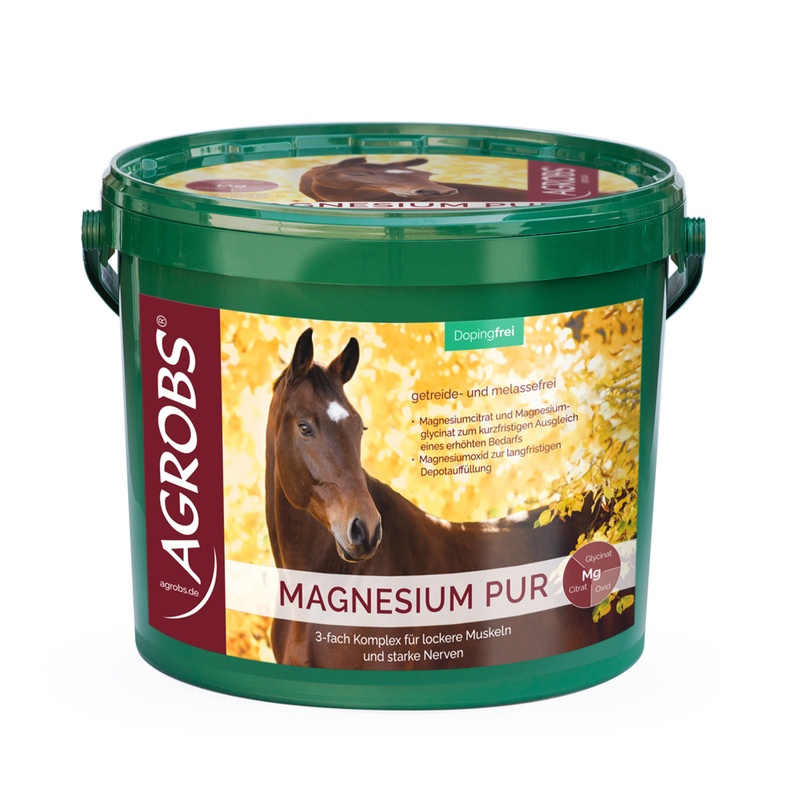
The ideal support for preventing or correcting a magnesium deficiency. Whether you use it for competitive or non-competitive purposes, MAGNESIUM PUR promotes muscle relaxation, strong nerves and bone mineralisation to help horses reach their full potential.The triple complex combines three sources of magnesium for optimal support:
Magnesium citrate and magnesium glycinate are an immediate, organically-bound source of magnesium for horses – for physical exertion during training or competition, increased perspiration or acutely stressful situations.
- By contrast, magnesium oxide is absorbed more slowly and helps build up the horse’s own magnesium reserves in the long term.
Thanks to this clever combination, the horse’s body can make use of the magnesium source that best meets its needs. The perfectly balanced blend also increases absorption in the intestines.

Dr. med. vet. Katharina Martin
Barbara Keßler, MSc. agr.
January 2024 ©AGROBS GmbH
Barbara Keßler, MSc. agr.
January 2024 ©AGROBS GmbH
Quellen:
• Coenen M, Vervuert I, Hrsg. Pferdefütterung. 6., aktualisierte Auflage. Stuttgart: Thieme; 2020
• F. Etemadi, A. T. Naeini, M. Aminlari. Assessment of calcium, phosphorus,magnesium, vitamin D and PTH levels in sera of lame horses. VetMed Sci. 2023;9:2070–2077.
• H. F. Hintz, H.F. Schryver. Magnesium metabolism in the horse.J Anim Sci 1972 Oct;35(4):755-9.
• Kew KM, Kirtchuk L, Michell CI. Intravenous magnesium sulfate for treating adults with acute asthma in the emergency department. Cochrane Database Syst Rev 2014;(5):CD010909 .
• L. Tanquerel, G. Fillion-Bertrand, J.-P. Lavoie, M. Leclere. Effects of magnesium sulfate infusion on clinical signs and lung function of horses with severe asthma. AJVR • Vol 79 • No. 6 • June 2018
· v. Engelhardt, Breves, Physiologie der Haustiere. 2. Auflage. Stuttgart: Enke Verlag; 2000.
· Stewart, A.J. Magnesium Disorders in Horses. Vet. Clin. N. Am. Equine Pract. 2011, 27, 149–163.
· Kayne L, Lee D. Intestinal magnesium absorption. Miner Electrolyte Metab 1993; 19:21–217
· R. Rylander. Bioavailability of Magnesium Salts – A Review. Journal of Pharmacy and Nutrition Sciences, 2014, 4, 57-59 57
• Silbernagl, Despopoulos. Taschenatlase der Physiologie, Thieme Stuttgart, 2003
• Toribio RE. Magnesium and Disease. In: Reed SM, Bayly WM, Sellon DC, editors. Equine Internal Medicine. Fourth edition. ed. St. Louis, Missouri: Elsevier; 2018. p. 1052–8.
• Quamme GA. Effect of calcitonin on calcium and magnesium transport in rat nephron. Am J Physiol. 1980; 238(6):E573–8.
• Swaminathan R. Magnesium metabolism and its disorders. Clin Biochem Rev. 2003; 24(2):47–66.
• J. Winter, S. Liertz, R. Merle, J. Aschenbach, H. Gehlen. Orale Supplementierung von Magnesiumaspartat-hydrochlorid bei Pferden mit Equinem Metabolischen Syndrom. Pferdeheilkunde 32 (2016) 4 (Juli/August) 372-377
• Barbagallo M., Dominguez L. J., Galioto A., Ferlisi A., Cani C., Malfa L., Pineo A., Busardo A., Paolisso G. (2003) Role of magnesium in insulin action, diabetes and cardio-metabolic syndrome X. Mol. Aspects Med. 24, 39-52
• Pham P. C. T., Pham P. M. T., Pham S. V., Miller J. M., Pham P. T. T. (2007) Hypomagnesemia in Patients with Type 2 Diabetes. Clin. J. Am. Soc. Nephrol. 2, 366-373
• S. Sheldon, M. Aleman, L. Costa, K. Weich, Q. Howey, J. Madigan. Effects of magnesium with or without boron on headshaking behavior in horses with trigeminal-mediated headshaking. J Vet Intern Med. 2019;33:1464–1472.
• Pizzorno L. Nothing boring about boron. Integr Med (Encinitas). 2015; 14:35-48
• Sheldon S, Aleman M, Costa L, Santoyo A, Howey Q, Madigan J. Alterations in metabolic status and headshaking behavior following intravenous administration of hypertonic solutions in horses with trigeminal-mediated headshaking. Animals. 2018;8:102.
• Sheldon S, Aleman M, Costa L, et al. Intravenous infusion of magnesium sulfate and its effect on horses with trigeminal‐mediated headshaking. J Vet Intern Med. 2019;33:923-932.
• J. Schuchardt, A. Hahn. Intestinal Absorption and Factors Influencing Bioavailability of Magnesium-An Update. Current Nutrition & Food Science, 2017, 13, 260-278
• Alfrey AC. Disorders of magnesium metabolism. In: Goldman E, Bennett JC, eds. Textbook of Medicine, 21st ed. Philadelphia, PA: WB Saunders; 2000:1137–1139.
• Dhupa N, Proulx J. Hypocalcemia and hypomagnesemia. Vet Clin North Am Small Anim Pract 1998;28:587–608.
• Chaudhary, D. P., Sharma, R. and Bansal, D. D. (2010): Implications of Magnesium Deficiency in Type 2 Diabetes: A Review. Biological Trace Element Research 134: 119-129.
• Alzaid, A. A., Dinneen, S. F., Moyer, T. P. and Rizza, R. A. (1995): Effects of insulin on plasma magnesium in noninsulin-dependent diabetes mellitus: evidence for insulin resistance. J Clin Endocrinol Metab 80: 1376-1381.
• Moritz A. Klinische Labordiagnostik in der Tiermedizin. Schattauer GmbH Stuttgart 2014
• B.W. Sykes, M. Hewetson, R.J. Hepburn, N. Luthersson, and Y. Tamzali. European College of Equine Internal Medicine Consensus Statement—Equine Gastric Ulcer Syndrome in Adult Horses. J Vet Intern Med 2015;29:1288–1299
• Leleu C., Couroucé A. Effect of a blend of magnesium oxide on Equine Squamous Gastric Disease in young trotter horses under training. J Vet Sci. 2023 Nov
• C Coudray, M Rambeau, C Feillet-Coudray, E Gueux, JC Tressol, A Mazur, Y Rayssiguier. Study of magnesium bioavailability from ten organic and inorganic Mg salts in Mg-depleted rats using a stable isotope approach. Magnes Res 2005 Dec;18(4):215-23.
• Barbagallo M., Dominguez L. J. (2007) Magnesium metabolism in type 2 diabetes mellitus, metabolic syndrome and insulin resistance. Arch. Biochem. Biophys. 458, 40-47
• Barbagallo M., Dominguez L. J., Galioto A., Ferlisi A., Cani C., Malfa L., Pineo A., Busardo A., Paolisso G. (2003) Role of magnesium in insulin action, diabetes and cardio-metabolic syndrome X. Mol. Aspects Med. 24, 39-52
• S. Fischer. Magnesium ist nicht gleich Magnesium. Deutsche Apotheker Zeitung online, 2021
• H.-H. Frey, W. Löscher. Lehrbuch der Pharmakologie und Toxikologie für die Veterinärmedizin. Enke Verlag Stuttgart 2002
• M. A. Razak, P. S. Begum, B. Viswanath, S. Rajagopal. Multifarious Beneficial Effect of Nonessential Amino Acid, Glycine: A Review. Hindawi Oxidative Medicine and Cellular Longevity Volume 2017
• Rapid recovery from major depression using magnesium treatment. Eby GA, Eby KL.Med Hypotheses. 2006;67(2):362-70. doi: 10.1016/j.mehy.2006.01.047. Epub 2006 Mar 20.
• M. Rondanelli, M. A. Faliva, A. Tartara, C. Gasparri, S. Perna, V. Infantino, A. Riva, G. Petrangolini, G. Peroni. An update on magnesium and bone health. Biometals (2021)
• Schmidbauer, C., Hofstätter, G. et al. 2022. Biogena Mikronährstoffcoach. 4. Auflage.